Bathroom Remodeling in Manor, TX: 2026 Costs & Process
A guest bathroom remodel in Manor that stays in its existing footprint typically runs $18,000–$32,000, a primary bath with a new layout, a curbless shower and relocated plumbing typically runs $35,000–$60,000, and a large wet room with custom tile, a freestanding tub and premium fixtures runs $60,000 and up. Most bathrooms take 3 to 5 weeks of construction once demolition starts, with design and permitting handled before that. Below is what moves your number inside those ranges, what the slab-on-grade houses around Manor change about the plumbing work, and how the permit and inspection sequence actually runs.
Already planning a bathroom remodel? Get a real price for your house →
What a Manor bathroom remodel costs, and what moves the number
Three things drive the price: whether the plumbing moves, how much tile there is, and what grade of fixtures and cabinetry you pick. Everything else is noise by comparison. Here is how the work sorts out in practice.
A refresh in the existing footprint — same toilet location, same drain, same tub or shower opening — is the cheapest path. You still get new tile, a new vanity, new lighting and new fixtures, but no concrete gets cut and no walls move. Expect $18,000–$32,000 for a hall or guest bath of 40 to 60 square feet.
A primary bath where the layout changes is a different job. Pulling a tub out, building a curbless shower, moving the toilet drain a few feet, adding a second sink, running a new dedicated circuit for heated floor — each of those adds trade hours and inspection stops. Expect $35,000–$60,000 depending on size and finish level.
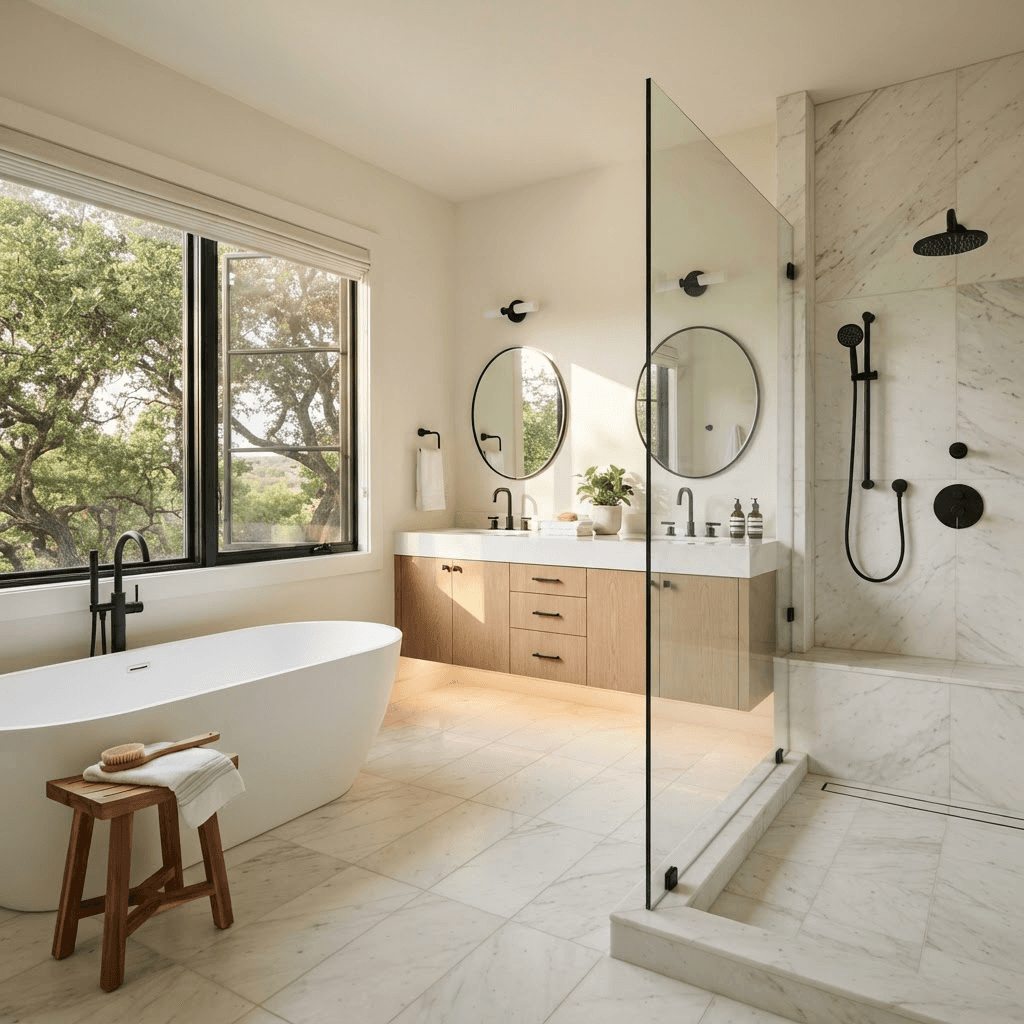
Above $60,000 you are generally in wet room territory: a fully waterproofed room with the tub and shower sharing one drained enclosure, slab-to-ceiling large-format or mosaic tile, a linear drain, niche and bench work, custom vanity cabinetry, and plumbing trim at the high end of the catalog. Those details are real labor, not markup.
- Moving a toilet or shower drain in a slab house: saw-cutting, re-routing, backfill and patch typically adds $2,500–$6,000.
- Curbless shower on a slab: the floor has to be recessed or the whole bathroom floor built up, typically $3,000–$7,000 over a standard curbed pan.
- Tile selection: a 12x24 porcelain field set in a running bond is far fewer labor hours than a herringbone floor with a mosaic shower wall. Tile labor swings can be $4,000–$9,000 on the same square footage.
- Vanity: a stock 48-inch unit versus an in-house built cabinet with a stone top is roughly a $1,800–$7,000 difference.
- Full replumbing of the bathroom branch — swapping old supply lines and drains instead of tying into them — typically adds $2,000–$5,000.
- Window or door changes, a relocated exhaust vent through the roof, or opening the ceiling for recessed lighting each add a few hundred to a couple thousand.
What is particular about bathroom work in Manor
Manor's housing stock splits into two groups, and they behave differently once the tile comes off.
The newer subdivisions built out along US-290 and FM 973 over the last twenty years are almost all slab-on-grade with PEX or CPVC supply lines and plastic drains. The plumbing is in good shape, so the money goes into design rather than repair. The constraint is the slab: every drain relocation means saw-cutting concrete, excavating, re-plumbing, pouring back and letting it cure. That is a real line item and a real two to three days in the schedule, which is why we settle the layout on paper before demolition rather than discovering it mid-job.
The older houses closer to downtown Manor and the original grid can have galvanized or cast-iron drains, smaller framing cavities, and bathrooms that were finished with mud-set tile over wire lath. Demolition takes longer, and it is common to find a drain line worth replacing while the floor is open. We allow for that in the fixed price rather than leaving you to absorb it later.
Climate matters here too. Central Texas summers are long and humid, and a bathroom with an undersized or poorly ducted exhaust fan will hold moisture in the drywall for years. On every Manor bathroom we size the fan to the room, duct it in rigid or insulated flex straight out through the roof or wall rather than into the attic, and put it on a timer or humidity sensor. The waterproofing behind the tile is a full bonded membrane system on the shower walls and pan — not just backer board and thinset — because that assembly is what keeps the wall dry for the next twenty years.
The other local reality is soil. Much of the Manor area sits on Blackland Prairie clay, which moves with the seasons. On large-format tile and curbless pans we use uncoupling membranes and movement joints so seasonal slab movement shows up as a joint doing its job instead of a cracked tile line.
Permits and inspections for a Manor address
Which office reviews your bathroom remodel depends on where the property sits. Some Manor addresses are inside the Manor city limits, some are in unincorporated Travis County, and some newer areas fall under other arrangements. We confirm the jurisdiction from the parcel record before design is finished, then we pull the permit, file the plans and schedule every inspection. You do not stand in line and you do not chase an inspector.
For a bathroom, a permit is normally triggered by the plumbing and electrical work — relocating a drain, adding circuits, changing fixture locations, altering the exhaust. Permit and plan review fees for a residential bathroom remodel typically run $300–$900 depending on the jurisdiction and the scope, and that figure is inside your fixed price, not added later.
If a project touches framing, a window opening, or anything that changes how the house carries weight, a licensed structural engineer and the permit office make that determination — not the contractor and not the homeowner. If your bathroom plan needs an engineer's letter or stamped detail, we tell you during design, bring the engineer in, and build it into the price before you sign.
The inspection sequence on a typical Manor bath looks like this: rough plumbing (with a pressure or water test on the lines), rough electrical, and where applicable a framing inspection — all before anything is covered. Then insulation and drywall, tile and waterproofing, and finally a plumbing and electrical final with the fixtures set. Each inspection is a scheduled stop, which is one reason a 3-to-5-week bathroom is not a 2-week bathroom.
The timeline, first visit to last fixture
Design and permitting happen before demolition, so the construction calendar we hand you is the one we build to. Here is the normal sequence for a Manor bathroom.
Construction itself is 3 to 5 weeks. A single guest bath in the existing footprint lands at the short end; a primary with a curbless wet room, relocated drains and custom cabinetry lands at the long end. Add the design and permit phase in front of it and most homeowners are looking at roughly 8 to 14 weeks from the first visit to the last fixture, depending on how quickly selections are made and how the review queue is running.
- Week 1 — In-home visit in Manor: measure, look at the existing plumbing and attic venting, talk through layout and budget range.
- Weeks 2–4 — Design and selections: plan drawings, tile, vanity, fixtures, lighting. Selections are locked before pricing is finalised.
- Week 4 — Fixed price in writing. Scope, allowances, materials and the construction calendar, all on one contract.
- Weeks 5–8 — Permit application, plan review, and ordering long-lead items such as custom cabinetry, stone tops and specialty plumbing trim so they are on site before they are needed.
- Construction week 1 — Protection, demolition, any slab cutting and drain relocation, rough plumbing.
- Construction week 2 — Rough electrical, framing changes, inspections, insulation and drywall.
- Construction weeks 3–4 — Waterproofing, tile setting and grout, vanity and cabinetry install, paint.
- Construction weeks 4–5 — Plumbing and electrical trim, glass, mirrors, final inspection, punch list and walkthrough.
How our fixed-price design-build process works
We design and build the job under one contract, which means there is nobody to point at when a detail does not work. The price you sign is the price you pay, and it is set after selections are made, not before. Allowances that drift are the single most common reason remodels blow past their quoted number, so we close them out during design: you pick the actual tile, the actual vanity, the actual faucet, and those SKUs go in the contract.
Our carpenters are in-house, not day labor rotated in by whoever is cheapest that month. The plumbing, electrical and tile work is done by the same trade crews we use week after week in and around Manor and east Austin, which is why the schedule holds. Workmanship carries a 5-year warranty in writing. Financing is available if you would rather not pull the whole amount from savings.
Change orders exist — you may see the framing open and decide you want a bigger niche — but they are priced and signed before the work happens. Nothing appears on an invoice you have not already approved.
What to ask any contractor before you sign
Use this list on every bid you take in Manor. The answers tell you more than the bottom-line number does.
When you are ready, the next step is a measured in-home visit at your Manor address. Bring the photos you have saved, a rough budget range, and a list of what annoys you about the bathroom now — that last one shapes the design more than anything on a mood board.
- Is this a fixed price or an estimate, and what happens if the number moves?
- Which tile, vanity, faucet and shower valve are in the price — by model, not by allowance dollar?
- Who pulls the permit and who meets the inspectors?
- What waterproofing system goes behind the tile, and is the shower pan flood-tested before tile?
- Where does the exhaust fan duct terminate, and what is the fan's CFM rating for this room size?
- If a drain has to move in the slab, how is the concrete patched and what does that add?
- Are the carpenters employees or subcontractors, and who is on site daily?
- What is covered by the workmanship warranty, for how long, and is it in writing?
- What is the written construction calendar, and what are the inspection stops in it?
Manor homeowners also ask
Do I need a permit for a bathroom remodel in Manor?
That depends on the scope and on which jurisdiction your address falls under — inside Manor city limits or unincorporated Travis County. The permit office makes that call, not us and not you. What we can tell you is that we confirm the jurisdiction, apply for the permit, submit the plans and schedule every inspection, and the fees are inside your fixed price. Fees for a residential bathroom remodel typically run $300–$900.
Can I keep living in the house during the remodel?
Yes, if you have a second bathroom. Most Manor homes do. We dust-wall the work area, run air scrubbers, and protect the path from the front door to the bathroom. If the only bathroom in the house is the one being remodeled, we talk through sequencing at the design stage so the toilet and a working sink are out of service for the shortest realistic window rather than the full 3 to 5 weeks.
How much more does a curbless shower cost than a standard one?
On a slab-on-grade house — which covers most newer Manor subdivisions — expect $3,000–$7,000 over a conventional curbed pan. The cost is in recessing the slab or building up the surrounding floor, the linear drain, and the extra waterproofing detail at the entry. On a pier-and-beam house the framing can sometimes be dropped instead, which changes the method but lands in a similar range.
Why does a bathroom take 3 to 5 weeks when the demo only takes a day?
Inspections and cure times set the pace. Rough plumbing and electrical have to be inspected before anything is closed up, mortar and grout need time, waterproofing needs to cure before it is flood-tested, and paint needs dry time before trim goes on. Pushing those steps is how tile cracks and showers leak two years later. Design and permitting happen before demolition so none of that waiting happens with your bathroom torn open.
Check it with Manor’s own pages
Permit rules and fees change, and the office that issues the permit is the authority on them, not this guide. These are its pages.