Home Additions in Spicewood, TX: Costs & Process 2026
A conditioned room addition in Spicewood typically runs $350–$550 per square foot, so a 400-square-foot addition lands around $140k–$220k, and a second-story addition usually starts higher at $550–$750 per square foot once stairs, roof work and a new bath are in the scope. Lot access, limestone rock at the foundation, and whether your house is on septic are the three things that move a Spicewood addition up or down that range faster than finishes do. Below is how the money breaks down, how the permit gets handled, and how long it takes from the first visit to the final walkthrough.
Already planning a home addition? Get a real price for your house →
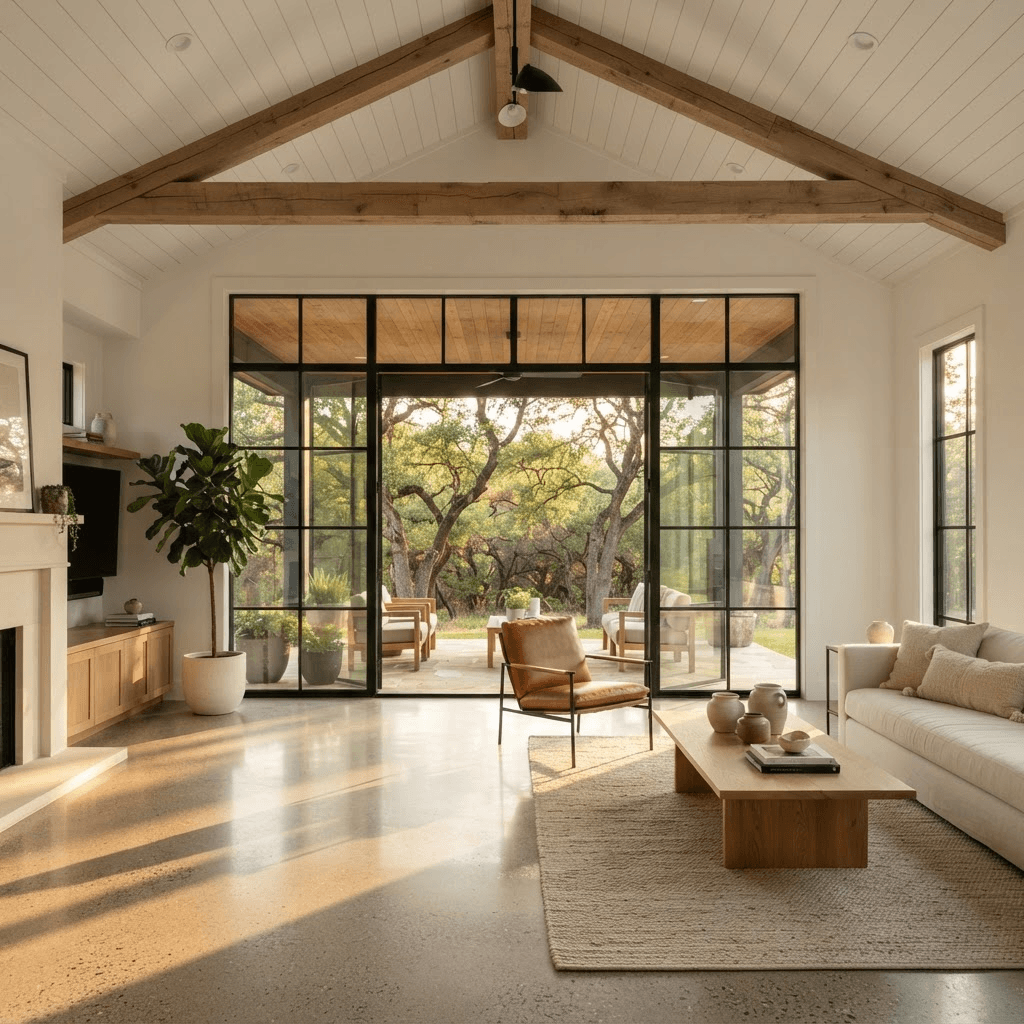
What a home addition costs in Spicewood
Additions are priced by square foot plus the cost of connecting to the house you already have. The connection is where budgets surprise people: tying a new roof into an old one, extending HVAC, running a new electrical circuit set, and re-siding a wall that is suddenly interior. Here are the ranges we work from before design, and we replace them with one fixed number in writing once drawings are done.
Two things to understand about the per-square-foot figure. First, it goes down as the addition gets bigger — a 200-square-foot bump-out carries the same setup, permitting and tie-in costs as a 600-square-foot room, spread over fewer feet. Second, it goes up the moment water is involved. A bedroom is framing, drywall, floor and trim. A bathroom or a kitchen inside the addition adds plumbing, venting, tile and fixtures, and those spaces follow the same economics as our standalone work — the kitchen ranges we publish start at $45k–$70k for a refresh in an existing footprint and climb to $70k–$110k when plumbing moves.
- Bump-out (closet, pantry, dining nook, 60–150 sf): $60k–$120k
- Single-story room addition, no plumbing (bedroom, office, living room): $350–$450 per sf
- Single-story addition with a bathroom or wet bar: $450–$600 per sf
- Primary suite addition with bath and closet, 400–600 sf: $180k–$340k
- Second-story addition or full second floor: $550–$750+ per sf
- Covered outdoor living added to the same build: $90–$160 per sf under roof
What moves a Spicewood addition up or down the range
Spicewood lots are not Austin infill lots. Most of what pushes a number here is site and systems, not cabinet door style.
Rock. Much of the ground west of Austin toward Lake Travis is shallow limestone over caliche. If footings or piers hit rock, excavation shifts from a machine-hours line item to rock removal, and that can add $4k–$15k depending on depth and access. We note it as a site condition during the first visit, and where the risk is real we price the removal into the fixed number rather than leaving it as a surprise.
Septic and well. Plenty of Spicewood properties are on an on-site septic system and a private well. Adding bedrooms or plumbing fixtures can change what the system has to handle. Whether your existing system can serve the new layout, or whether it needs modification, is determined by a licensed on-site sewage facility designer and the county authority that reviews it — not by us and not by you. Budget $1,500–$4,500 for the evaluation and permit work if a review is triggered, and more if the designer calls for a new drain field.
Access and slope. Long, narrow or steep driveways mean smaller delivery trucks, more trips and hand-carrying material. A hillside lot where the addition sits over a drop needs taller piers or a deck-style foundation. Either one can add $8k–$25k compared with a flat pad.
Roof and foundation geometry. Matching an existing roof pitch and extending a slab is routine. Threading a new roof under an existing ridge, or building a second story over a footprint that was never planned for one, is engineering work first and carpentry second. A licensed structural engineer designs that connection and the permit office reviews it.
Finish level. Standard trim, builder-grade windows and painted drywall sit at the bottom of the range. Site-finished hardwood, custom built-ins from our own shop, tall windows and a stone fireplace push a 500-square-foot addition up $30k–$70k on their own.
Permits and inspections for a Spicewood address
Spicewood addresses are spread across Travis County and Burnet County, and some fall inside an extraterritorial jurisdiction tied to the City of Austin. Which office reviews your plans depends on the exact parcel, and that is the first thing we confirm — before design hours get spent. We handle City of Austin permit submittals as a matter of course, and for county-reviewed addresses we prepare and submit the same package to the reviewing authority.
Plan your budget for the paperwork, not just the lumber. Across the area, permit and review fees for an addition typically run $1,200–$4,000 depending on square footage and valuation, with engineering for the foundation and framing connection usually $1,500–$4,000 and a site survey or plot plan $500–$1,200. If your property sits in a subdivision with an HOA or deed restrictions, architectural approval is a separate submittal with its own calendar, and some Lake Travis–area properties also sit in watershed or impervious-cover review areas that add a step.
What we will not do is tell you a permit is unnecessary, or tell you a wall can be opened. The permit office decides what is required, and a licensed engineer decides what the structure can do. Our job is to get the drawings, the engineering and the submittal in front of them, respond to comments, and meet every inspector on site.
- Confirm the reviewing jurisdiction for your parcel (county, ETJ or city)
- Survey or plot plan showing setbacks and impervious cover
- Engineered foundation and framing plans where the review requires them
- Septic review by a licensed designer if fixtures or bedrooms are added
- HOA or deed-restriction approval where it applies
- Inspections at foundation, framing, rough mechanical/electrical/plumbing, insulation and final
A realistic timeline, first visit to final walkthrough
Design and permitting happen before demolition. That is why the construction calendar we hand you is the one we build to — we are not drawing while framing.
Weeks 1–2: site visit, measurements, scope conversation, and a preliminary budget range for your actual house. Weeks 2–8: design, selections and engineering. This is where you pick windows, flooring, cabinetry and plumbing fixtures, because every one of those is a line in the fixed-price contract. Weeks 6–14: permit submittal and review. County and city review times vary, and outside agency or septic review adds weeks, so we track it and keep you posted rather than guessing at a date.
Construction: 10–16 weeks for a bump-out or a simple single-story room, 16–28 weeks for a primary suite or a multi-room addition, and 24–36 weeks for a second story where the house has to be weather-protected while the roof is off. For reference against our other work, a bathroom inside the addition takes 3 to 5 weeks of its own sequence, a kitchen 6 to 10 weeks, and a whole-home renovation runs 4 to 8 months — if you are combining an addition with a gut of the existing house, plan on the longer end.
All in, most Spicewood additions run 7 to 14 months from the first visit to the final walkthrough, and the design-and-permit half of that is usually longer than homeowners expect.
How our fixed-price design-build process works
One contract covers design, engineering coordination, permitting and construction. You are not managing an architect on one side and a builder on the other, and nobody gets to blame the drawings for a change order.
We price the job after design is finished and selections are made, not before. That price is written into the contract and it does not move unless you change the scope or the permit office or engineer requires something that could not be seen before demolition — and in that case you get the revised number in writing before anyone picks up a tool. Framing, trim and built-ins are done by our own carpenters, which is how we hold both the schedule and the finish quality on hill-country jobs where the nearest sub is not five minutes away. Workmanship is covered by a 5-year warranty, and financing is available if you would rather not tie up cash in a construction draw schedule.
When you interview contractors in Spicewood, ask these and compare the answers, not the brochures:
- Is the price fixed in writing before demolition, and what specifically can change it?
- Who prepares and submits the permit package, and who meets the inspectors?
- Have you built on shallow rock and on properties with septic and well service?
- Are the carpenters your employees or a subcontracted crew that rotates?
- What does the schedule say about the weeks between permit submittal and the first day on site?
- What exactly does the workmanship warranty cover, and for how long?
- Can I see the full selections list that the price is based on?
What to do next
Write down three things before you call anyone: what the addition has to accomplish (a bedroom for a parent, a real office, a bigger kitchen), the budget number you do not want to cross, and whether you are on septic or on a utility connection. Those three answers decide most of the design within the first hour.
Then book a site visit. We measure, look at the roofline, the slab edge, the electrical panel and the route a concrete truck would take, and we give you a preliminary range for your specific house — not a national average. If the range works, we move into design, selections and engineering, and the fixed price in writing follows from that.
Spicewood homeowners also ask
Does a Spicewood addition need a City of Austin permit?
It depends on your exact parcel. Spicewood addresses fall under Travis County, Burnet County, or in some cases an extraterritorial jurisdiction connected to the City of Austin, and the reviewing authority decides what is required. We confirm which office reviews your address at the first visit, prepare the package including engineered plans where they are required, submit it, respond to comments and meet every inspector. You do not chase the paperwork.
How much does a 500-square-foot addition cost in Spicewood?
Typically $175k–$275k for a single-story addition without plumbing, and $225k–$340k if it includes a bathroom and closet as a primary suite. Shallow limestone at the foundation, a steep or hard-to-access lot, a septic review, and site-finished or custom millwork all push toward the top. A simple flat-pad addition with standard windows and painted trim sits at the bottom. The fixed price comes after design and selections are complete.
Can I add a second story to my Spicewood house?
Whether an existing foundation and walls can carry a second floor is determined by a licensed structural engineer, and the permit office reviews that engineering before anything starts. We bring the engineer in during design so the answer arrives before you have spent money on finishes. When a second story is feasible, budget $550–$750+ per square foot and 24–36 weeks of construction, since the house has to stay weather-protected while the roof comes off.
How long will my house be a construction site?
For a bump-out, 10–16 weeks on site. For a primary suite or multi-room addition, 16–28 weeks. For a second story, 24–36 weeks. Add the design, selections, engineering and permit review that happen first, and most Spicewood additions run 7 to 14 months from the first visit to the final walkthrough. Design and permitting are finished before demolition, so the construction calendar we hand you is the one we build to.
Check it with Spicewood’s own pages
Permit rules and fees change, and the office that issues the permit is the authority on them, not this guide. These are its pages.