Bathroom Remodeling in Buda, Texas: 2026 Cost Guide
A guest bath remodel in Buda usually lands between $18,000 and $30,000, a primary bath redone inside its existing walls runs $30,000 to $55,000, and a gutted primary with a curbless shower, a moved drain and a new layout runs $55,000 to $90,000 and up. Construction takes 3 to 5 weeks once demo starts, with design and permitting handled before that. Here is what drives the number up or down, how the permit works depending on which side of the city line you live on, and what to ask before you sign anything.
Already planning a bathroom remodel? Get a real price for your house →
What a bathroom remodel costs in Buda
Price follows three things: the size of the room, whether water lines and drains move, and the level of finish you pick. Everything else is noise. We quote a fixed price in writing before anyone swings a hammer, so the number below is the number you pay unless you change the scope yourself.
Most Buda houses built in the subdivision boom of the last 25 years have a standard 5-foot tub in the hall bath and a garden tub with a separate framed shower in the primary. Replacing those in place is the cheap end. Taking the garden tub out, pushing the shower into that corner and building a curbless wet room is the expensive end, because the drain has to move and the slab has to be opened.
- $18,000–$30,000 — guest or hall bath in the existing footprint: new tub or tub-to-shower conversion, tile walls and floor, vanity, toilet, lighting, exhaust fan, paint.
- $30,000–$55,000 — primary bath in the existing footprint: larger tile area, double vanity, frameless glass, new shower valve and trim, upgraded lighting and venting.
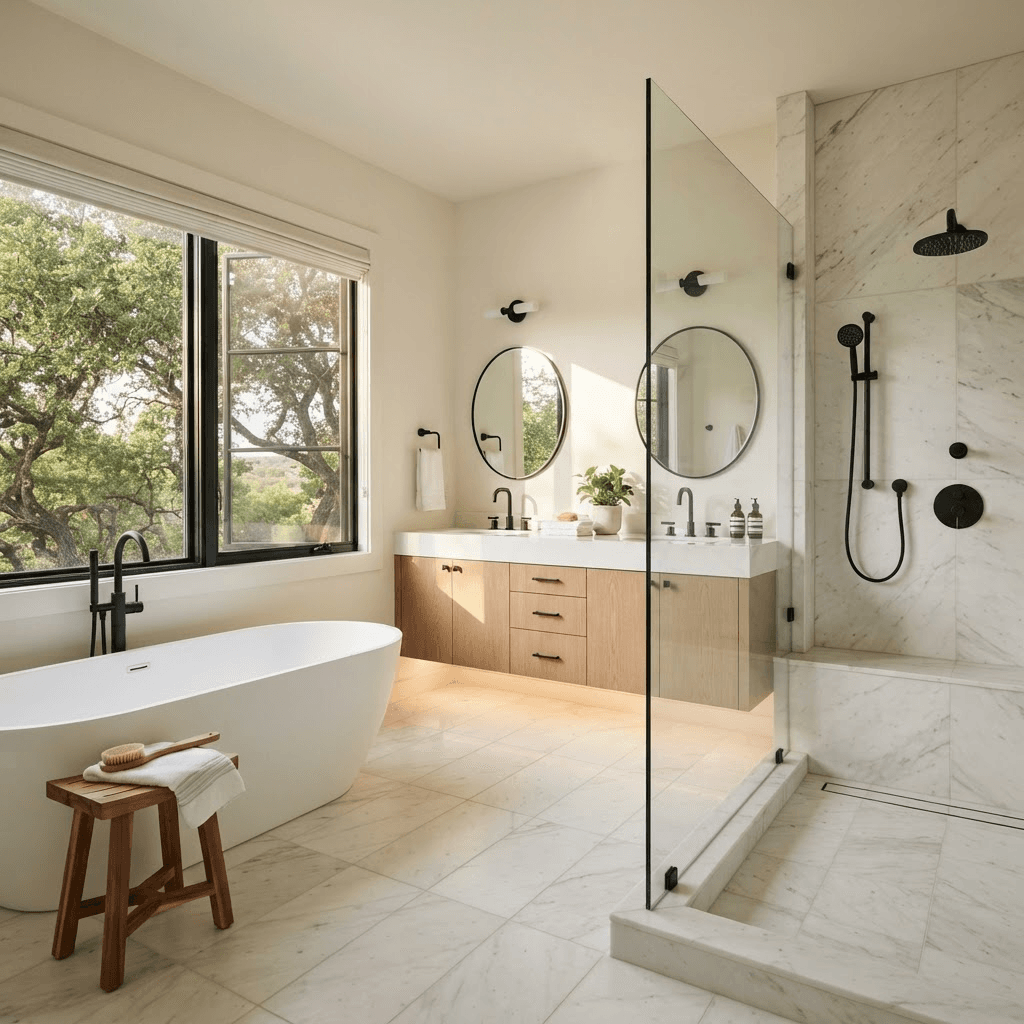
- $55,000–$90,000+ — primary bath with the layout changed: curbless or wet-room shower, relocated drains and supply lines through a slab, freestanding tub, custom vanity, niche and bench tile work, heated floor.
- Adds that move you up a range: moving a drain through a slab ($3,000–$7,000 depending on the run), frameless glass over standard framed ($1,800–$4,500), full replumb of a dated supply system, large-format or mosaic tile with heavy layout, custom cabinetry instead of semi-custom, and widening a doorway.
- Things that keep you down a range: leaving the toilet and drain where they are, a single vanity, a porcelain tile that reads like stone instead of actual slab, and a standard-height ceiling with no soffit changes.
What is different about bathroom work in Buda
Nearly every house in the newer Buda neighborhoods sits on a post-tensioned or conventional slab on grade. That matters more in a bathroom than anywhere else in the house, because any new shower drain, tub drain or toilet flange in a new spot means cutting and re-pouring concrete. On a post-tensioned slab the cables have to be located before anyone cuts, and that scanning and the engineering sign-off belong to a licensed engineer — we bring one in and build the cost into the fixed price rather than discovering it in week two.
Hill Country water on this side of I-35 is hard. Scale builds on shower glass, chrome and aerators faster here than in soft-water parts of the country. It is worth deciding early whether you want a whole-house softener tied in while walls are open, and it is worth choosing a glass coating and a valve brand whose cartridges you can still buy in ten years.
The older houses around downtown Buda and the original streets off Main are a different animal from the Sunfield and Garlic Creek era homes. Expect cast iron or galvanized waste lines, smaller bathrooms carved out of a back hall, and framing that was never built for a 60-inch vanity. Those projects usually include some replumbing, and we price that in from the start after we open a small inspection area.
Permits and inspections for a Buda bathroom
Which office reviews your job depends on where the house sits. If you are inside Buda city limits, the City of Buda building department handles it. If your address is Buda but you are actually in unincorporated Hays County, the county handles it. Plenty of homeowners on the edges of town are surprised by which one they fall under — we confirm the jurisdiction from the address and the plat before we price the job.
We pull the permit and schedule the inspections. You do not chase paperwork or sit in a lobby. Plumbing, electrical and, where applicable, framing and final inspections are scheduled around the build calendar so the trades are not standing still waiting on an inspector.
Whether a particular wall can be opened, a door widened or a slab cut is not a call we make from a photo. A licensed engineer and the permit office make that determination, and the plan they approve is the plan we build. Budget for permit fees in the $150–$600 range for a typical residential bathroom scope, more if structural or engineering review is involved; the engineer's work on a slab-penetrating project typically adds $600–$2,000. Those numbers sit inside your fixed price, not on top of it.
If your neighborhood has an HOA — most of the newer Buda developments do — interior bath work is rarely their business, but anything that touches the exterior, like a new exhaust vent penetration or a window change, can be. Check your covenants before design is locked.
The timeline, week by week
From the first visit to a finished bathroom, plan on roughly 7 to 13 weeks total for a straightforward job and longer if the layout changes or engineering is involved. Construction itself is 3 to 5 weeks. The rest is design, selections, permitting and material lead times — all of which happen before demolition so the construction calendar you get is the one we build to.
We do not start demo until the permit is in hand and the tile, vanity, glass and fixtures are on site or confirmed. That single rule is why bathrooms here do not sit half-finished for a month waiting on a shower base.
- Week 1 — Site visit. We measure, look at the existing plumbing, check the attic and the slab situation, and talk through scope and budget.
- Weeks 1–3 — Design and selections. Layout drawings, tile and fixture choices, cabinet sizes. You see a fixed price in writing at the end of this stage.
- Weeks 3–6 — Permitting and ordering. We submit to the City of Buda or Hays County and order long-lead items. Frameless glass is templated after tile, so it lands later by design.
- Week 1 of construction — Demo, haul-off, and any slab cutting or rough plumbing relocation. Rough electrical. Inspection.
- Week 2 — Shower pan or wet-room build, waterproofing, backer board, and a flood test on the pan before a single tile goes down.
- Weeks 3–4 — Tile setting, grout, vanity and countertop, toilet, trim carpentry by our own crews, paint.
- Weeks 4–5 — Fixture trim-out, mirrors, glass install, final inspection, punch list, walkthrough.
How our fixed-price design-build process works
Design and construction sit under one contract. You are not hiring a designer, then bidding the drawings out, then arguing about who owns a mistake. We draw it, price it, permit it and build it with our own carpenters, and we carry a 5-year workmanship warranty on what we install.
The price is fixed in writing before demolition. It changes only if you change the scope — you want the freestanding tub after all, or you add the softener. In that case you get a written change order with a number on it before we proceed. There is no hourly drift and no end-of-job reconciliation.
Financing is available if you would rather not pull the whole project out of savings. Ask about it during the design stage so the payment schedule and the construction schedule line up.
What to ask any Buda contractor before you sign
The questions below separate a real proposal from a napkin estimate. Any contractor who cannot answer them in writing is asking you to accept a number that will move later.
Do the same for yourself before the first meeting: take photos of the existing bathroom, find the attic access, note whether you have one bathroom or two, and decide whether the household can live through 3 to 5 weeks with one bath down. If it is the only full bath in the house, say so early — the sequence changes.
- Is this a fixed price or an allowance-heavy estimate? Which line items are allowances, and what happens when I exceed them?
- Who pulls the permit, and have you confirmed whether my address falls under the City of Buda or Hays County?
- If the drain has to move, who scans the slab and who stamps the engineering?
- Are the carpenters and tile setters your employees or day-rate subs, and who is on site every day?
- What is the workmanship warranty, in years, in writing, and what does it exclude?
- What is the waterproofing system behind the tile, and will you flood-test the pan before tiling?
- When do materials have to be selected, and will demo start before they are on site?
- What does the payment schedule look like, and what triggers each draw?
Buda homeowners also ask
Do I need a permit for a bathroom remodel in Buda?
Assume a permit is part of the job and let the permit office make the call on scope — that is their decision, not ours or yours. We confirm whether your address falls under the City of Buda or unincorporated Hays County, submit the application, and schedule the plumbing, electrical and final inspections. Permit fees for a typical residential bathroom usually run $150–$600 and are included in your fixed price.
Can I turn my garden tub into a big walk-in shower?
That is the most common request we get in Buda primary baths, and it is usually a good use of the space. The honest answer is that it depends on where the drain sits and what the slab allows. We have a licensed engineer evaluate a post-tensioned slab before anything is cut, and the permit office reviews the plan. Expect a curbless or wet-room conversion with a relocated drain to put you in the $55,000–$90,000 range for a full primary bath.
How long will my only bathroom be out of service?
Construction runs 3 to 5 weeks for a bathroom, and the room is unusable for essentially all of it. If it is the only full bath in the house, tell us at the first visit — we sequence the rough plumbing, inspection and tile stages tighter and get the toilet reset as early as the inspection schedule allows. We will not start demo until the permit and the materials are both in hand, which is what keeps that window from stretching.
Why is your price higher than a bid I got from a handyman?
Different scope. A fixed price from us includes design drawings, the permit and inspections, engineering where a slab is involved, a tested waterproofing system behind the tile, our own carpenters rather than day labor, and a 5-year workmanship warranty. A lower number usually means allowances that move, or work done without a permit on record — which becomes your problem when you sell the house in Buda's resale market.
Check it with Buda’s own pages
Permit rules and fees change, and the office that issues the permit is the authority on them, not this guide. These are its pages.