Garage Conversion & ADU in Westlake, TX | Fixed Price 2026
A garage conversion in Westlake typically runs in the same range as a mid-level kitchen project — roughly $45,000 for a straightforward conditioned room with a bathroom, and up toward $120,000 and beyond once you add a full kitchen, separate entry, and new HVAC. A detached ADU is a home addition in every practical sense, so it prices and schedules like one. We give you a fixed price in writing before demolition starts, so the number you sign is the number you pay.
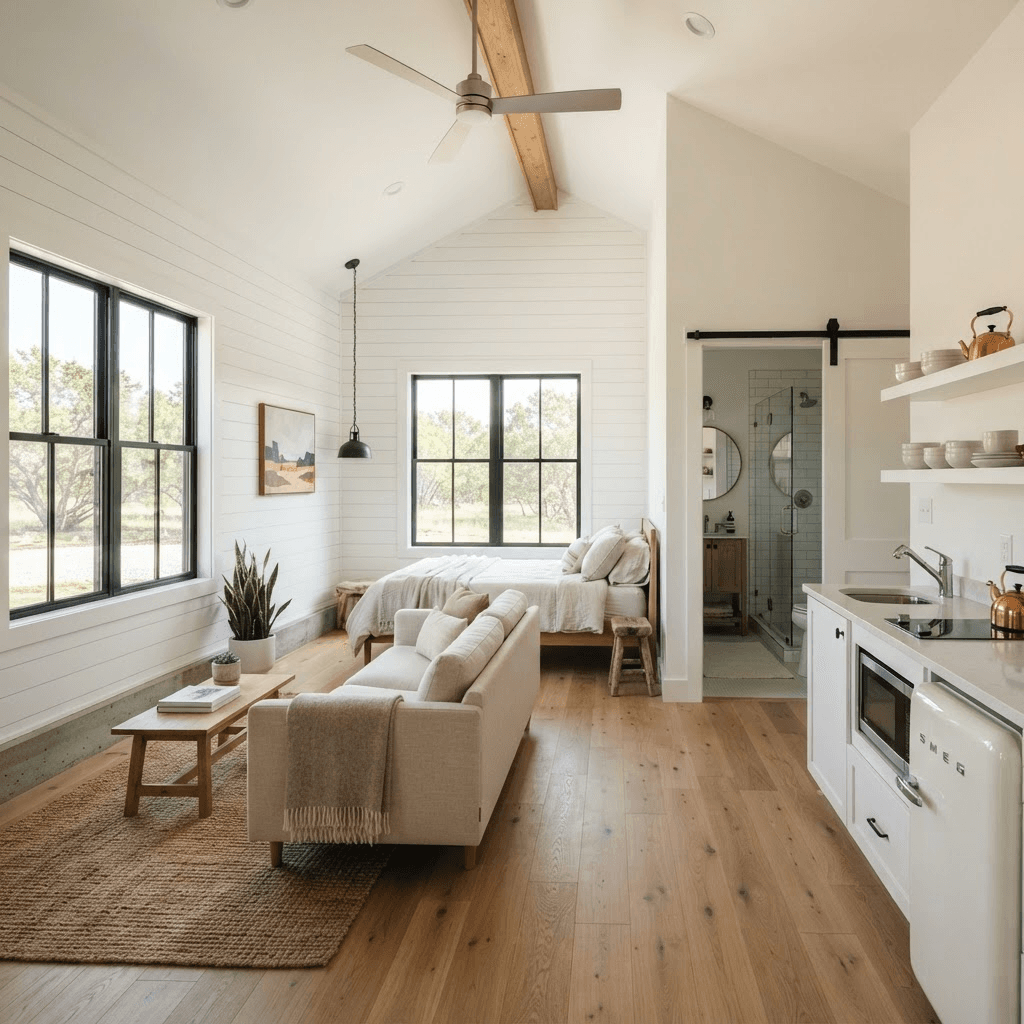
What a Westlake Garage Conversion Actually Costs
Cost comes down to how much of a house you are building inside the existing slab. Converting a two-car garage into a conditioned office, gym, or guest suite means insulating walls and roof, raising or leveling the slab at the door opening, framing in the garage door, running electrical, and tying into or adding HVAC. Add plumbing for a bathroom and the scope grows again. Add a kitchen and you are building a legal dwelling unit, which brings its own requirements.
A detached ADU in the hills west of Loop 360 is more expensive per square foot than a conversion because you are pouring a new foundation, building a new roof, and trenching new utility runs — often across sloped, rocky Westlake lots where excavation is slow work. We price that as a home addition and put the number in writing before anyone swings a hammer.
- Conditioned room conversion, no plumbing: lower end of the range, typically 4 to 6 weeks of construction
- Conversion with a full bathroom: expect bathroom scope to add 3 to 5 weeks of work inside the overall schedule
- Full ADU conversion with kitchen, bath, separate entry and dedicated HVAC: pushes toward and past $120,000, similar to a high-end kitchen build
- New detached ADU: priced as a home addition; foundation, roof and utility trenching are the biggest cost drivers
- Financing is available if you would rather not tie up cash or touch your mortgage
Permits and Inspections Around Westlake
Westlake is not one jurisdiction. Depending on your exact address you may be in the City of West Lake Hills, the Village of Rollingwood, unincorporated Travis County, or inside Austin's limited-purpose or full-purpose city limits. That matters, because the plan review and inspection path is different for each, and so is the timeline. We confirm your jurisdiction from the address and the appraisal district record before we draw anything.
We handle City of Austin permits directly, and we file with West Lake Hills, Rollingwood, or Travis County when that is where your property sits. Expect the local items that come up on hillside lots: impervious cover limits, tree protection for heritage oaks, setback and height review, septic approval from Travis County if you are not on sewer, and floodplain or slope review near the creeks. If your neighborhood has an HOA or deed restrictions on secondary dwellings, we will flag it during design rather than after you have paid for plans.
Adding a second kitchen usually reclassifies the space as a dwelling unit. That triggers separate life-safety requirements — egress, smoke and CO alarms, energy code, sometimes parking. Design and permitting are finished before demolition, so the inspections do not stall your schedule.
- Jurisdiction confirmed by address: West Lake Hills, Rollingwood, Travis County, or City of Austin
- Impervious cover and tree protection review, which is where most hillside ADUs get trimmed
- Septic capacity review with Travis County when a bedroom or kitchen is added off-sewer
- Rough-in inspections for framing, electrical, plumbing and mechanical, then final before occupancy
How Our Fixed-Price Design-Build Process Works
We design and build with the same crew, so nobody hands you a set of plans and walks away from the price. The sequence is simple: site visit and measure, feasibility check against your jurisdiction's rules, design and material selections, then a fixed-price contract with a construction calendar attached. Permitting and plan review happen next. Demolition only starts after the permit is in hand.
Our carpenters are in-house employees, not day-rate subs rotating between jobs. That is how we hold a schedule and why we back the work with a 5-year workmanship warranty. Change orders only happen if you decide to change something — the price does not drift because a material went up or a sub bid came in high.
- Fixed price in writing before demolition
- Construction calendar you can plan around, handed over with the contract
- In-house carpenters on your job, not a rotating sub crew
- 5-year workmanship warranty
- Permits filed and inspections managed by us
Choosing Between a Conversion and a Detached ADU
If you want a home office, media room, gym, or guest suite and you can live without covered parking, converting the existing garage is the cheaper and faster path — the slab, walls and roof already exist. Westlake homeowners with circular drives or a second bay usually do not miss the space.
If the goal is rental income, aging-parent housing, or resale value from a genuinely separate unit, a detached ADU is generally the better asset. It keeps your garage, gives real privacy, and reads as a second residence to appraisers and tenants. The tradeoff is cost and a longer schedule closer to a small whole-home project than a single room.
One more practical note: Westlake lots are often steep and heavily treed. A detached ADU has to fit setbacks, height limits, impervious cover, and tree protection zones all at once. We check that in feasibility, before you spend money on design.
Timelines You Can Plan Around
Design and permitting run before construction, not during it. Budget several weeks for design and selections, then plan review time that depends on your jurisdiction — Travis County and the smaller cities move on their own calendars.
Once we mobilize, a simple conversion is a matter of weeks. A conversion with a bathroom carries the 3 to 5 week bathroom scope inside it. A full ADU conversion with a kitchen behaves like a kitchen project at 6 to 10 weeks. A new detached ADU runs months, closer in structure to a whole-home renovation's 4 to 8 month rhythm depending on size, foundation work and utilities. Whatever the number is, it goes on the calendar we hand you, and that is the calendar we build to.
Westlake homeowners also ask
Can I legally rent out an ADU in Westlake?
It depends on your jurisdiction and your deed restrictions. City of Austin rules differ from West Lake Hills, Rollingwood, and unincorporated Travis County, and many Westlake neighborhoods have their own restrictions on secondary dwellings and short-term rentals. We verify the rules for your specific address during feasibility, before you pay for design, so you are not surprised after the fact.
Will converting my garage hurt resale value in Westlake?
It can if you eliminate all covered parking on a street where every comparable home has a two-car garage. Buyers in this market expect parking. If you have a second bay, a porte-cochere, or generous driveway space, a well-finished conditioned room usually adds value. If parking is tight, a detached ADU is the safer investment.
Do I need a septic review for an ADU?
If your property is on septic rather than sewer, yes. Travis County reviews whether your existing system can handle added bedrooms or a second kitchen, and sometimes the answer is a system upgrade or expanded drain field. We identify that early because it is a real line item, not a footnote.
Is the price really fixed?
Yes. We give you a fixed price in writing before demolition starts, and it does not move because of material costs or sub pricing. The only changes are ones you request. Financing is available if you would rather spread the payment out.