Outdoor Living in Austin, TX: Costs & Process (2026)
Most Austin outdoor living projects we build start with a covered patio and grow from there — a shaded slab, a grill run with counter space, or a deck that steps off the back door. Scope drives the number: a straightforward covered patio is a different budget than a full outdoor kitchen with gas, water and drainage. Whatever you choose, you get a fixed price in writing before anyone swings a hammer.
What Outdoor Living Costs in Austin
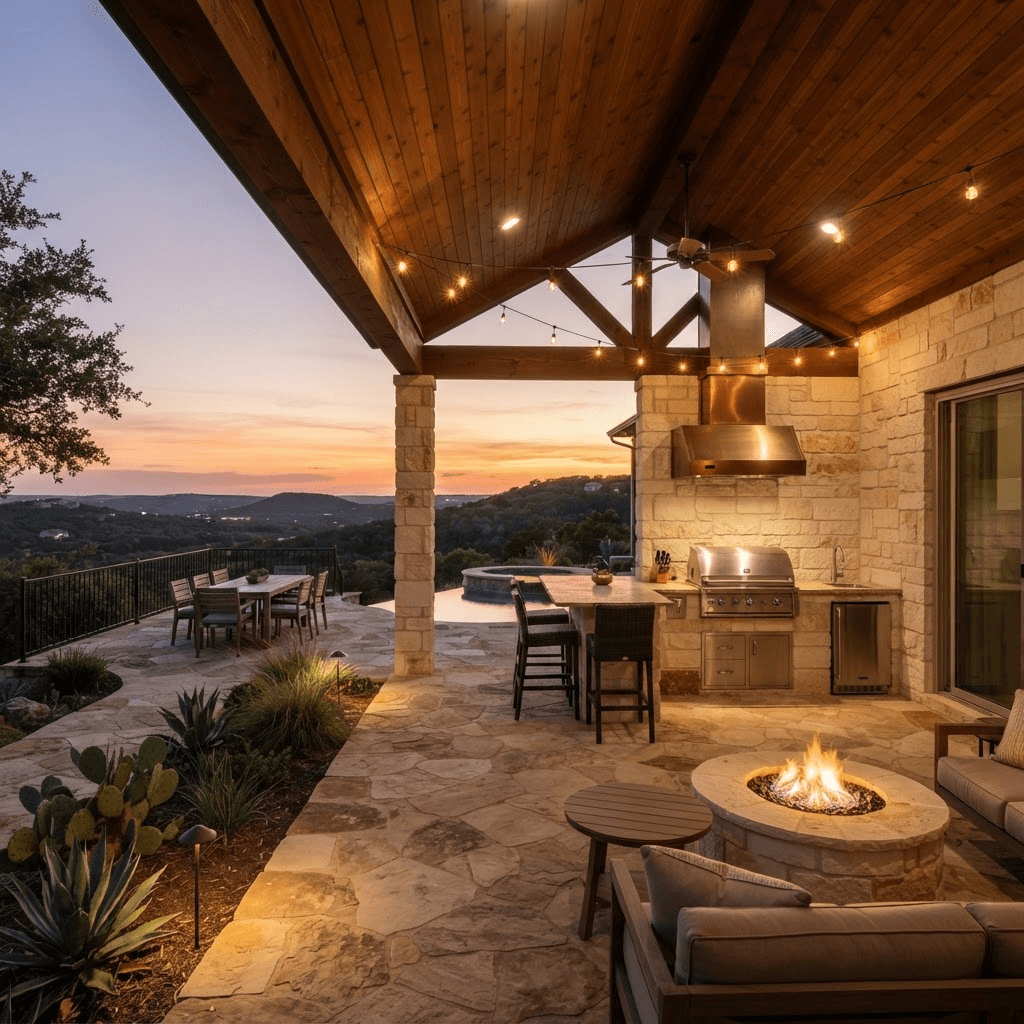
Pricing tracks three things: the structure over your head, the utilities you run out there, and the finishes you pick. A covered patio with a matching roofline, ceiling fans and recessed lighting is the anchor cost. Add an outdoor kitchen and you are adding plumbing, gas and appliance-rated cabinetry — that is where budgets move.
For comparison, most Austin kitchen remodels we build land between $45,000 and $120,000, and an outdoor kitchen borrows a lot of the same trades: counters, cabinetry, gas, water and electrical. The difference is that everything outside has to survive 100-degree Augusts, hard freezes and driving spring rain, so the material spec is different.
We do not quote outdoor work off a square-foot guess. We walk the yard, look at your existing roof framing, check drainage and setbacks, then hand you one fixed number.
- Covered patio: structure, roof tie-in, ceiling fans, lighting, drainage
- Outdoor kitchen: grill, gas line, sink and drain, weather-rated cabinets, stone or concrete counters
- Deck: framing, decking material, stairs, rails, and footing depth for Central Texas soil
- Extras that move the price: fireplaces, outdoor TVs, misting systems, screened enclosures
Built for Central Texas Heat and Weather
Austin punishes outdoor construction. UV fades and chalks cheap finishes in two summers. Expansive clay soil around parts of Travis and Hays County heaves and shrinks with the wet-dry cycle, which is why deck footings and slab detailing matter more here than in most of the country. Then a freeze shows up and splits any water line that was not run and insulated correctly.
We spec for that. Kiln-dried framing under cover, exterior-rated fasteners, stainless or powder-coated hardware, and stone or sealed concrete counters rather than interior materials pushed outside. Outdoor kitchen water lines get a shutoff and a drain point so you can winterize in an afternoon.
Orientation matters too. A west-facing patio in Austin bakes from 3 p.m. on. Deeper overhangs, a screened side, or a reoriented layout can be the difference between a space you use and one you look at.
City of Austin Permits and Inspections
A covered patio is a structural addition in the eyes of the City of Austin. Anything with a roof and foundation goes through the residential permit process, and that means a site plan showing setbacks and impervious cover. Impervious cover limits are the item that surprises Austin homeowners most — a new slab counts against your lot's allowance, and if you are already near the cap, we adjust the design before you spend money on it.
Electrical, gas and plumbing for an outdoor kitchen pull their own trade permits and their own inspections. Uncovered decks under a certain height and size may not need a building permit, but the electrical still does. If your property sits in a Travis County or Hays County unincorporated area, the review is different and usually faster, and we handle that too.
We pull the permits, post them, and meet the inspectors. Design and permitting happen before demolition, so the construction calendar we hand you is the one we build to.
- Site plan with setbacks, easements and impervious cover calculations
- Residential building permit for covered structures
- Separate electrical, plumbing and gas permits for outdoor kitchens
- Additional review if you are in a floodplain, heritage tree zone or a neighborhood with a conservation overlay
How Our Fixed-Price Design-Build Process Works
One company designs it, permits it and builds it, so there is nobody to blame when a detail falls through. We start with a site visit and a budget conversation — real numbers, not a range you cannot plan around. From there we draw the patio or deck, pick materials, and price every line.
Then you get a fixed-price contract in writing. That number does not move unless you change the scope or we open something up and find rot, a failed footing or a code issue that has to be corrected. Allowances get set at real prices, not lowball placeholders that blow up in month two.
Our carpenters are in-house, not a rotating cast of subs. That is how framing, decking and trim details stay consistent, and it is why we back the work with a 5-year workmanship warranty. Financing is available if you would rather not pull it all from savings.
How Long It Takes
Design and permitting run first. City of Austin review time varies with workload, and you should plan for it rather than hope around it. Once the permit is in hand, a covered patio is typically a few weeks of on-site work; an outdoor kitchen adds time for trades, counter templating and appliance delivery.
For scale on our other work: a bathroom runs 3 to 5 weeks, a kitchen 6 to 10 weeks, and a whole-home renovation 4 to 8 months. Outdoor projects sit on the shorter end of that spread, with weather as the main variable — you cannot pour concrete or set a roof in an Austin spring downpour.
You get a written construction calendar at contract signing, and we build to it.
Choosing an Austin Outdoor Living Contractor
Ask for the number in writing. A verbal estimate that starts with 'roughly' is a negotiation waiting to happen halfway through the job. Ask who is pulling the permit — if the answer is that you pull it as the homeowner, you are taking on the liability, not them.
Ask whether the crew is employed or subcontracted, and ask what the warranty covers and for how long. Then ask for addresses of covered patios they built three or four summers ago, and go look at how the finishes held up in Austin sun.
- Fixed-price contract before demo, not a time-and-materials estimate
- Contractor pulls the City of Austin or county permits under their name
- In-house carpenters on the framing and finish work
- A written workmanship warranty — ours is 5 years
- A construction calendar with dates, not seasons
Austin homeowners also ask
Do I need a permit for a covered patio in Austin?
Yes. A roofed structure on a foundation requires a residential building permit from the City of Austin, along with a site plan showing setbacks and impervious cover. Electrical, gas and plumbing for an outdoor kitchen pull separate trade permits and inspections. We handle all of it, including scheduling and meeting the inspectors.
Will a new patio slab put me over my impervious cover limit?
It can, and it is the most common reason an Austin outdoor plan gets redrawn. We run the impervious cover numbers during design, before you have paid for construction drawings you cannot use. If you are close to the cap, there are options — permeable paving, a smaller footprint, or removing existing hardscape elsewhere on the lot.
Can you connect the outdoor kitchen to my existing gas and water?
Usually yes, depending on where your meter and main lines sit and whether the existing service has capacity. We check that during the site visit, because running a new gas line 60 feet across a yard costs real money and it belongs in the fixed price, not in a change order later.
Is the price really fixed?
Yes. You get one number in writing before demolition starts, and it holds unless you change the scope or we uncover something hidden that code requires us to fix — a failed footing, rotted framing at the roof tie-in, or unpermitted existing work. We show you the condition and the cost before we touch it.